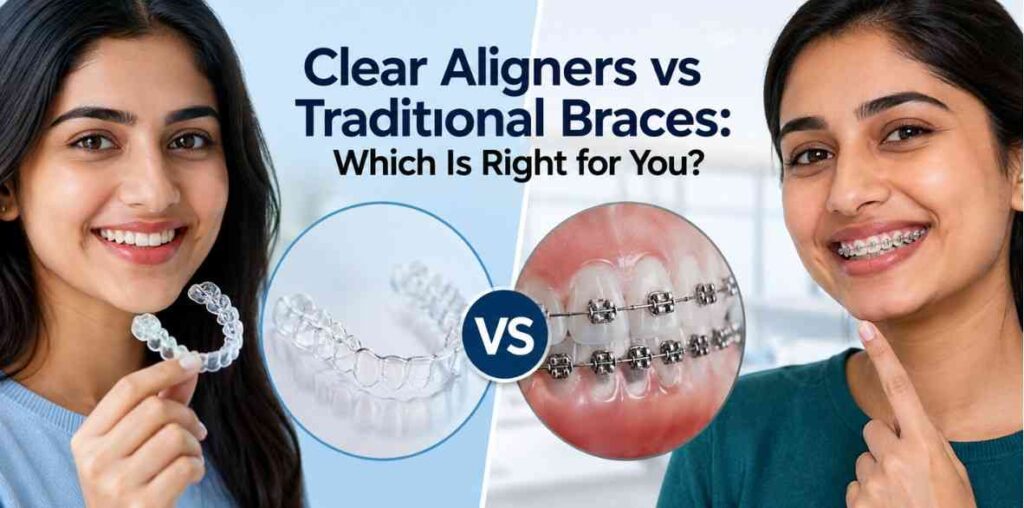
What Are Clear Aligners?
Clear aligners are a series of custom-fitted, transparent plastic trays designed to gradually move your teeth into a straighter position. Each tray is worn for about one to two weeks before moving to the next one in the series, with each new aligner making small adjustments to tooth position. Because they’re made of clear medical-grade plastic, they’re far less noticeable than metal brackets, which is why they’ve become popular among adults and working professionals.
Aligners are removable, meaning you take them out to eat, brush, and floss. This is one of the biggest lifestyle differences compared to braces.
What Are Traditional Braces?
Traditional braces consist of brackets bonded to the front of each tooth, connected by an archwire that’s tightened periodically by your dentist or orthodontist. The wire applies continuous, gentle pressure that moves teeth into alignment over time. Braces can be metal or ceramic (tooth-colored), and they stay on your teeth throughout treatment — you don’t take them out.
Because the pressure is constant and the appliance can’t be removed or forgotten, braces are often the more predictable option for correcting complex bite problems, significant crowding, or cases involving jaw alignment.
Clear Aligners vs Braces: Side-by-Side Comparison
Appearance
Aligners: Nearly invisible, clear plastic
Braces: Visible metal or ceramic brackets
Removability
Aligners: Removable for eating, brushing, and special occasions
Braces: Fixed in place for the entire treatment
Comfort Aligners: Smooth edges, generally less irritation to cheeks and lips Braces: Brackets and wires can cause minor irritation, especially after adjustments
Oral Hygiene Aligners: Easier — remove trays to brush and floss normally Braces: Requires more care and specific tools to clean around brackets and wires
Best For
Aligners: Mild to moderate crowding, spacing, and bite issues
Braces: Mild to complex cases, including significant crowding and bite correction
Discipline Required
Aligners: High — must be worn 20 to 22 hours a day to stay on track Braces: Low — no daily removal decisions, dentist controls the pace
Diet Restrictions Aligners: Minimal — remove trays before eating anything Braces: Some foods to avoid (sticky, hard, or very chewy items)
Visits to the Dentist Aligners: Periodic check-ins, often less frequent Braces: Regular adjustment visits, typically every few weeks
Cost Aligners: Comparable to or somewhat higher than braces, depending on case complexity and system used Braces: Generally more predictable and often more budget-friendly for complex cases
How Clear Aligners Work
The process usually begins with a digital scan or impression of your teeth, which is used to create a 3D treatment plan. This plan maps out the entire journey — from your current tooth positions to the final result — and a series of aligners is manufactured to match each stage of that movement.
You wear each tray for the prescribed number of days, then move to the next in the sequence. Small attachments (tooth-colored bumps) are sometimes bonded to certain teeth to help the aligners grip and apply more precise force where needed. Your dentist checks progress at intervals to make sure teeth are moving as planned, and can adjust the treatment plan if needed.
How Traditional Braces Work
Braces work through continuous mechanical pressure. Brackets are bonded to each tooth, and a wire threaded through them is periodically tightened or replaced with a different type to apply the right amount of force in the right direction. Elastic bands or other small attachments may be added to correct bite issues, such as an overbite or underbite.
Because the pressure is constant rather than dependent on the patient remembering to wear something, braces tend to move teeth in a very controlled, predictable manner — particularly useful for cases involving jaw alignment or severe crowding.
Cost Comparison: Aligners vs Braces
Cost is one of the most common questions patients ask, and it’s also one of the most misunderstood. There’s no fixed number that applies to everyone, because cost depends on:
- How complex your bite or alignment issue is
- How many aligners or bracket adjustments your case requires
- The brand or system of aligners used
- Whether ceramic or metal brackets are chosen for braces
- The length of overall treatment
In general, simple to moderate cases tend to cost less regardless of the method chosen, while complex cases requiring longer treatment cost more. It’s common for clear aligners and traditional braces to fall in a similar cost range for straightforward cases, with aligners sometimes costing more for cases needing additional attachments or refinement trays.
The most reliable way to know your actual cost is a consultation, where your dentist can examine your bite, take X-rays if needed, and give you a treatment plan with transparent pricing — rather than relying on rough estimates that may not reflect your specific case.
Treatment Duration: What Affects It
A lot of patients ask, “how long do clear aligners take to work?” The honest answer is: it depends far more on the complexity of your case than on which method you choose. Both aligners and braces can address mild issues in a shorter timeframe, while more involved bite corrections take longer with either option.
Several factors affect duration:
- Severity of crowding or spacing
- Whether a bite correction (overbite, underbite, crossbite) is involved
- Patient compliance (especially important with aligners, since they must be worn consistently)
- How closely scheduled check-ins are followed
- Whether any teeth need extraction to create space
Your dentist can give you a realistic, case-specific timeline once they’ve assessed your teeth — general online estimates rarely apply accurately to an individual case.
Who Is a Good Candidate for Clear Aligners?
Clear aligners tend to work well for patients who:
- Have mild to moderate crowding or spacing
- Want a discreet, less visible treatment option
- Are disciplined enough to wear trays for the recommended hours each day
- Don’t have complex bite issues requiring more mechanical control
- Want the flexibility to remove the appliance for eating, presentations, or events
- Have good oral hygiene habits already, since aligners require regular cleaning of both teeth and trays
Because aligners depend on consistent wear, they suit patients who can commit to the routine — missing hours of wear time regularly can slow down or affect the result.
Who Is a Good Candidate for Braces?
Traditional braces are often recommended for patients who:
- Have moderate to severe crowding or spacing
- Need correction of bite issues like overbite, underbite, or crossbite
- Are younger patients, including teenagers, whose compliance with removable trays may be inconsistent
- Have complex tooth rotations that need more precise mechanical control
- Prefer a fixed solution that doesn’t rely on remembering to wear something
Braces remain a dependable option for many patients precisely because the treatment doesn’t rely on the patient remembering to put something back in their mouth.
Comfort, Diet, and Daily Life
Comfort levels differ between the two options, though neither is typically described as painful — more like an adjustment period. Aligners can feel like light pressure for the first day or two of each new tray, while braces may cause some soreness immediately after adjustments as the wire is tightened.
For daily life, aligners offer more flexibility. You remove them to eat, so there’s no need to avoid your favorite foods. Braces come with a shorter list of foods to be cautious with — sticky, hard, or very chewy foods can damage brackets or wires, so your dentist will usually walk you through what to avoid.
Speaking clarity is another factor some patients notice. Aligners occasionally cause a slight lisp for the first few days as your tongue adjusts, which typically resolves quickly. Braces don’t usually affect speech in the same way.
Oral Hygiene and Maintenance
One advantage of clear aligners is the ease of cleaning — since they’re removable, you brush and floss your teeth exactly as you normally would, then clean the aligner tray separately with a soft brush and lukewarm water.
Braces require a bit more effort. Food particles can get trapped around brackets and wires, so patients typically use:
- A soft-bristled or orthodontic toothbrush
- Interdental brushes to clean between brackets and wires
- Floss threaders or a water flosser to reach under the wire
- Fluoride mouthwash for extra protection against decay around brackets
Good oral hygiene matters equally with both options — leaving plaque around brackets or inside aligner trays for extended periods can lead to staining, gum irritation, or cavities.
Risks of Delaying Orthodontic Treatment
Putting off treatment for crowded, gapped, or misaligned teeth doesn’t just affect appearance. Over time, misalignment can make teeth harder to clean properly, which raises the risk of plaque buildup, gum inflammation, and tooth decay in hard-to-reach spots. Bite issues left uncorrected can also contribute to uneven wear on certain teeth and, in some cases, jaw discomfort.
This isn’t meant to alarm anyone — many people live with mild misalignment without major issues. But if your dentist has already flagged a bite problem or noticeable crowding, it’s worth having a conversation about your options sooner rather than later, since some issues become more complex to treat as time goes on.
Prevention Tips for a Smoother Treatment Journey
Whether you choose aligners or braces, these habits help treatment go more smoothly:
- Keep up with scheduled dental visits so your dentist can track progress and catch issues early
- Maintain a consistent oral hygiene routine, brushing at least twice daily
- If you choose aligners, stick to the recommended wear time of 20 to 22 hours a day
- Avoid skipping trays or wire adjustments, since consistency directly affects treatment timeline
- Use a fluoride toothpaste and consider a fluoride rinse if recommended by your dentist
- Address any cavities or gum issues before starting orthodontic treatment, since a healthy foundation makes treatment more predictable
Frequently Asked Questions
- Are clear aligners better than braces for adults? Not necessarily “better” — they’re often more convenient for adults because they’re discreet and removable, but suitability depends on your specific bite and alignment needs. Some adults with more complex bite issues may still be better suited to braces. A dental consultation is the best way to know which fits your case.
- Do clear aligners actually work as well as braces? For mild to moderate alignment and spacing issues, clear aligners can be just as effective as braces. For more complex bite corrections, braces sometimes offer more predictable control. Effectiveness ultimately depends on your case and how consistently aligners are worn.
- Is the cost of clear aligners always higher than braces? Not always. Cost depends on the complexity of your case, the number of aligners or brackets required, and the specific system used. Some simple cases cost similarly across both options, while complex cases can shift the cost either way. A consultation will give you a specific number.
- Can I switch from aligners to braces (or vice versa) partway through treatment? In some cases, yes — your dentist may recommend switching if your case isn’t progressing as expected with aligners, or if a bite issue requires more mechanical correction. This is decided on a case-by-case basis after an in-person evaluation.
- Will I need a retainer after finishing treatment with either option? Yes. Both aligners and braces require a retainer afterward to help hold teeth in their new position, since teeth can gradually shift back without one. Your dentist will recommend a wear schedule based on your case.
When Should You See a Dentist?
If you’re noticing crowded or overlapping teeth, visible gaps, difficulty cleaning certain areas of your mouth, or a bite that doesn’t feel quite right when you chew, it’s worth scheduling a consultation. Even if your misalignment seems mild, a dentist can assess whether early treatment would prevent more complex issues later.
It’s also worth seeing a dentist if you’ve already started aligner or brace treatment elsewhere and have concerns about progress, discomfort, or fit — getting a second opinion is always reasonable when it comes to your oral health.
Why Choose Smile Care Dental Hospital, Kothapet?
Choosing where to get orthodontic treatment matters just as much as choosing the treatment type itself. At Smile Care Dental Hospital in Kothapet, patients are evaluated individually rather than given a one-size-fits-all recommendation — your bite, your goals, and your lifestyle all factor into the treatment plan suggested to you.
The clinic’s dental team has experience working with both clear aligner systems and traditional braces, which means the recommendation you receive is based on what suits your teeth, not on which treatment the clinic prefers to sell. Modern diagnostic tools, including digital scans and imaging, help create more accurate treatment plans and give patients a clearer picture of what to expect before committing to a plan.
Patient comfort and clear communication are treated as part of the treatment itself — you should never leave a consultation confused about your options, your costs, or your timeline. If you’re weighing clear aligners against braces, a conversation with the team here can help you make a decision based on your actual bite, not general assumptions.
Conclusion
There’s no universal winner in the clear aligners vs braces debate — the right choice depends on your bite complexity, your budget, your daily habits, and how much discretion you want during treatment. Clear aligners suit patients who want a nearly invisible, removable option and can commit to consistent wear. Traditional braces remain a dependable choice for more complex bite corrections and patients who prefer a fixed, no-maintenance-decision appliance.
The most reliable next step is a professional evaluation — X-rays, a bite assessment, and a conversation about your goals will tell you far more than any general comparison can. If you’re in Kothapet and considering straightening your teeth, booking a consultation at Smile Care Dental Hospital is a good starting point to get a treatment plan built around your specific case.